Showing posts with label School. Show all posts

Saturday, May 31, 2014

Commencement

Today I participated in the commencement exercises for my Master of Arts in Theology from The University of Scranton. It was a beautiful day!


My husband was there in his full adacemic dress. He is so distinguished, and has been such a support to me as I completed my degree. I was so grateful he was present in all of his own academic glory to cheer me on.

#academicspouses

Also in attendance were my mom, my in-laws, my friend Teresa, and of course my Bookie. Twice during the ceremony speakers recognized the spouses, children, parents, and families of the graduates, as integral to our success in our graduate studies. The graduates were also given an opportunity to recognize our families through a round of applause. This meant a lot to me, that my new alma mater understands that our education is so dependent on the communities of which we find ourselves a part, including and especially our families.

From the program; image by @uofslibrary

The president of the university at one point declared us all "sons and daughters of the university forever." This, again, meant a lot to me, since I already serve this university as a member of the faculty, and now I can call it my forever-home as a student as well.


Paul, Bookie and I posed for a photo outside the Chapel of the Sacred Heart on our campus, which is the exact spot where Paul and I first met in person in December 2010. My, how far we've come in just three and a half years. God has blessed us immensely.


One speaker during the ceremony noted that "commencement" means beginning, and that this moment signifies the beginning of the part of our professional lives to be animated by our graduate study. I like this, as I am now a librarian who has the degree of Master of Arts in Theology, and this is a subtle but important difference from the librarian I was before I completed my course of study.

I guess it's time to commence this next phase of my professional life, with all of the responsibility it entails. May God bless it.

Tuesday, January 14, 2014

Status Updates on Various Fronts

It has been an eventful month! I want to share here some of the things going on, but due to the quantity I will need to do so in short bursts of photos and text.

Bookie looking contemplatively out of our living room
window. Yes she's wearing three headbands.
***

The Metaliteracy MOOC ended in December. Unfortunately, due to the rigorous nature of applying for promotion during the month of October, I fell behind in the MOOC talks and was unable to catch back up. I do have links to all the content, though, and in particular would like to engage with Sue Thomas' Technobiophilia material sometime in the future. Metaliteracy is definitely still my thing, and I learned most from the MOOC by getting to put it into practice and watch others do the same. And it still promises to be a big part of the revised ACRL Information Literacy Standards, due to be completed this summer. So, this MOOC was definitely time well spent.

And, it resulted in this gem appearing in the #metaliteracy Twitter stream a few weeks into the course:


Nothing quite like scanning and absorbing 140-character soundbytes on a complex educational framework like metaliteracy, only to stumble upon one instance of a lone user creating anew the hashtag #metaliteracy which, in context, refers to the music genre of heavy metal, and even includes the requisite sign of the horns emoticon to be legit. Loved this. Decentralized vocabularies ftw :)

***

In December, I officially graduted with my Master of Arts in Theology. In the first weeks of January, the degree was finally in my possession.

#fiveyearsofmylife #worthit
Very exciting, that.

***

Also in the first weeks of January I had my meeting before the Board on Rank and Tenure. This board consists of eleven of my senior colleagues here at my institution, who have been reviewing for the past 1.5 months my massive application for promotion to the rank of Associate Professor. Our Provost was also present at the meeting. The purpose of the meeting was for the board to ask me questions of clarification about my application, consisting of evidence related to my librarianship, scholarship, and service. At the end of the meeting, after I left, the board voted on whether or not to recommend to the university president that I be promoted -- after I left the room, of course. I find out the result of this vote, as well as the president's decision, later this spring.

Here is what I looked like a few minutes before driving to campus the day of my meeting.

All gussied up (to the extent that I gussy up)
#goodimpression #zen #calmcoolcollected 
The meeting went very well as far as I can tell! (Thank God!) I was certainly nervous, but not so to the point where I was spewing verbal red flags in my responses. The tone in the room was serious but collegial. I was asked questions by four of the board members, and I was in the room for around twelve minutes.

Anyone reading, who is of the praying kind, I'd be grateful for prayers that my application is a successful one...promotion would mean a lot of things for me, both personally and professionally. This was arguably one of the most important meetings of my career thus far. I will assuredly post here with the results of the process.

***

Bookie is very much the toddler these days! This week she began in the next room up at day care, which has more structure and opportunities to develop now that she is running all over the place and pre-talking up a storm. And she did great on her first day in the new room! I'm so proud of her. Here are a few Bookie photos of Bookie being her Bookie-self, with one of me and Paul at Christmastime thrown in for good measure.


Christmas at our parish
Christ is born! Touch ALL the ornaments!

#daddydaughter #myloves

Tea time, thanks to a beautiful gift from
her Aunt T (aka my research
partna' and friend, Teresa) :)

#choirloftpixie at church
on a Sunday morning

#choirloftZEBRApixie at the
sippy cup waterhole

Conducting AND singing along
with Maria Callas #operagirl

Me and my darling :) 

***

And finally, there's this...

#throughglass, but not, because I took this w/ my ol'
 fashioned smartphone -- BUT STILL.

...about which I have many words. I am going to tell the story of this crazy awesomeness in another post, though, as the number of words in this post has reached quota.

Thursday, November 7, 2013

Master's Thesis: Link to Full Text

Screen grab of the record for my thesis in the Masters Theses Collection at my library (click to embiggen)
Not long after I successfully defended my Master's thesis, I submitted both the print and electronic versions to my library's digital services department to be added to our Masters Theses Collection. In the spirit of open access, I decided to grant the library permission to make my thesis viewable electronically to the public, worldwide. Once my thesis was live in the collection, my thesis advisor noted: "From defense to global accessibility in 6 days...that's remarkable. And accessed it should be." (Very kind of him.) I agree that it's exciting to think that my thesis is now available for scholars to read, but I'm even more excited that this enables me to share my work with those in my life who are interested in reading it: family, friends, and church folk.

So, without further ado, here is the link to my thesis. If you do decide to click over and skim or read part or all of it, I would love to hear your thoughts and feedback, no matter what the context is in which you are reading it (i.e., fellow Orthodox Christian, fellow theology scholar, fellow librarian interested in things-scholarly, or close friend or family member -- or any other group I may be missing!).

Saturday, October 19, 2013

Master's Thesis: Defended + Acknowledgments and Introduction

Image source via Pinterest.
Yesterday afternoon, I successfully defended my Master's thesis, titled:

"Now lay aside all earthly cares": 
Knowledge of God through Christian Worship

Although there is still paperwork to file, the physical degree to confer, and my commencement ceremony to partake of, at the conclusion of my defense I became a Master of Arts in Theology. I am excited about the work I produced, and relieved to have finally accomplished this important milestone. Besides the personal fulfillment it brings, it is also a requirement for applying for both promotion in academic rank and tenure in my position of Assistant Professor on the library faculty at my school. I plan to apply for promotion this year, with the deadline of November 1st for submitting my application materials, so completing and defending my thesis this month was a necessity, and one I am proud to have accomplished.

When I posted the news yesterday on Facebook, first that the defense was occurring later that afternoon, then that my defense was a success, I also included the title of the thesis in my status update, and many people in my life expressed an interest in reading it. I am about 95% sure that I will give my library permission to make the digitized version of the thesis accessible to anyone who knows the link or searches for it in our library catalog. I have a newly developed commitment to open access and to making my work available to be found, read, and engaged with...a commitment which has the freedom to blossom in the wake of having accomplished two publications in blind peer-reviewed journals in my field--publications which unfortunately are not at present openly accessible. I hope to rectify that in some way soon, but in the meantime, I wrote my thesis not just for me, but for anyone who participates in worship, especially in the Orthodox Christian context. I can't justify keeping the work behind an access wall. Which is all to say, unless my mind on this matter changes between now and filing the paperwork for the completed thesis, I will post the link to the full version on my blog once that process is complete. 

All of this being said, there are two short excerpts I want to share now, right here in the body of this blog post. One is my Acknowledgments page, because I want to be able to easily link to and share my thanks to these individuals, so I can share them sooner rather than later. The other is my Introduction, which is around three pages long. This lays out my research question, and my proposed answer to it, and explains how I go about demonstrating the answer over the course of the thesis (i.e., which writers I draw from and to what ends I do so). This second excerpt will be of interest to anyone for whom the title of the work sounds like something you want to read more about. The Introduction also begins with a reflection on my personal experience of worship, from which my research question sprang, so it is also a glimpse into my perspective as a choir singer in an Orthodox Christan parish. So, without further ado, here are the excerpts, to which I invite feedback and response.
Acknowledgments  
I am very grateful to many for the support, prayers, insights, and influence that have led to this completed work. 
To my colleagues and administrators in the Library Department here at The University of Scranton: thank you for your support and flexibility as I completed my coursework, and then researched and wrote this thesis. I couldn’t have done it without you behind me. 
To my instructors in the graduate theology program: thank you for helping to form my thinking throughout the program as I approached this capstone research project; and thank you especially to Dr. Nathan Lefler and Dr. Maria Poggi Johnson, for your time and expertise in reading and offering feedback on this work.  
To my classmates in the program: I truly believe that learning happens in community, and your presence in the classroom with me as we attempted to wrap our feeble minds around the mysteries of God was a gift. Thank you.  
To Dr. Will Cohen: thank you for your time and willingness to guide me through this work, and for your valuable insights that helped me transform a rambling research idea rooted in personal experience into a fully-formed work that manages to maintain its heart.  
To my mother, Celia, my father, Jack (Memory Eternal.), and my brother, John: I wouldn’t be the scholar I am today without your encouragement; thank you for giving me the confidence to pursue what fulfills me and for always making my work feel worthwhile.  
And, to Paul and Anna: thank you for being my reason for sitting down at the computer and cranking this work out. I did it for you, with love. 

Introduction  
As a member of the choir in an Orthodox Christian parish, my experience of the liturgy—from the Greek leitourgia, popularly understood to mean “work of the people”[1]—is at once beautiful and, at times, puzzling. Every Sunday I attend the liturgy, during which I sing and participate, along with my fellow parishioners, in communal worship. The entire service is sung through, with the choir singing the responses on behalf of the faithful, though what I offer here can easily apply to any other manner of service during the liturgy, including simply standing actively at prayer. For the hour and a half or so that I am in church for the service, it often feels like time stands still—or, in some sense, ceases to exist. While singing the prayers and hymns of the liturgy, the most fulfilling moments are when I can’t hear my own voice, when my voice gets absorbed into the greater work of the choir as a whole. These are also the moments when time does not seem to exist in the same way it does when I am focused on singing technique, or paying close attention to how I sound in reference to the singers around me. These moments of timelessness during the liturgy are restful—they are what I look forward to every week when I go to church. And yet, it takes work to achieve them: the work of getting myself and my family to church each Sunday, learning the music, understanding the prayers, developing my vocal instrument, and so on. 
This experience is not unique to me. Hilarion Alfeyev, Metropolitan of Volokolamsk in the Russian Orthodox Church, describes his own experience of worship in the liturgy in the following manner:
Orthodox divine services are characterized by inner integrity and astounding beauty. . . . The entire service is conducted as if in one breath, in one rhythm, like an ever unfolding mystery in which nothing distracts one from prayer. . . . two hours are never sufficient for me, since the time goes by so quickly and the dismissal comes too soon . . . [due to] the sweetness of communion with God and the unearthly stillness and calm that enter the soul while serving the liturgy . . . (n. pag.)
Alfeyev’s experience mirrors mine, but he would be the first to agree that despite this gift we’re given in liturgical worship, the act itself requires much of us if it is to successfully yield to an experience like the one described here. It is this paradox, at once beautiful yet puzzling, that drove the research of my inquiry and defined the question of this thesis: How is this work, rest? 
The simplest form the answer to this question might take is to say: This work is rest because in it and through it we come to know God. The aim of this thesis is to articulate how this occurs, where the Incarnation of God in Christ makes possible man’s participation in the divine through worship and liturgy. To this end, Chapter I focuses on foundational ideas from Plato and Aristotle of how the human soul, containing reason and intellect, can be said to participate in the divine; these ideas are later taken up by Christianity and applied to the act of worship. Chapter II offers the thought of Saints Augustine (354-430 A.D.) and Maximus the Confessor (c.580-662 A.D.) on the topic of how knowledge of God is understood in the Christian context; several key shifts in emphasis from this topic’s treatment in antiquity are identified and developed, including the expansion of man’s participation in the divine to include the human body as well as the soul, and the apophatic character of God where man’s access to true knowledge of God (i.e., “mystical theology”) is mediated by an encounter between God and the Body of Christ (i.e., the community of believers) joined in a dynamic unity through divine worship. Chapter III moves the discussion to the twentieth and twenty-first centuries, when a generation apart Catholic philosopher Josef Pieper and Eastern Orthodox theologian Andrew Louth engage in questions related to human reason and intellect and how these work together to enable us to achieve our highest humanity: to know God in a manner both human and divine. Chapter IV brings the inquiry full circle, drawing on the above scholars, as well as twentieth century Eastern Orthodox theologians Alexander Schmemann and Georges Florovsky, to demonstrate how worship is both the primary activity through which we come to know God, and, our loving response to that knowledge. 
Before proceeding, a disclaimer must be offered. The irony is not lost on me that I am offering a work that hopes to articulate the nature of how we come to know God, when the “answer” to this question is that, for the Christian believer, this knowledge is made possible in and through divine worship centering on the Eucharist. As my priest is wont to say, the simplest and most effective response to an inquirer’s question, “Who is the Christian God?” is: Come and see (cf. John 1:46), coupled with an invitation to attend liturgy some Sunday morning.[2] That being said, and as will hopefully be made clear in the following work, a rigorous critical engagement with the question has an important purpose to serve, for such inquiries help to prepare and condition the mind toward the restful anticipation required of us to fully enter into divine worship, enabling us to come to know God in and through the process. 
[1] The popularizing of this definition can be traced to the pastorally oriented liturgical theology of Alexander Schmemann; as Stefanos Alexopoulos explains, “Indeed, seeing ritual as a magical act is a real danger in highly ritual traditions, including the Orthodox, and I believe it is this danger that moved Schmemann and others after him to define liturgy as the ‘work of the people.’ While in the North American Protestant and possibly Catholic setting emphasis on this definition might limit or even diminish the understanding of the Eucharist as God’s gift, in an Orthodox setting there is need to emphasize the involvement and role of the community” (see pp. 288-289 of “Did the Work of Fr. Alexander Schmemann Influence Modern Greek Theological Thought? A Preliminary Assessment” in St Vladimir’s Theological Quarterly 53 (2009): 273-299). 
[2] The role and function of catechesis in preparing a person for entering fully into the community of faith presents an important tension that exists between the Orthodox Church’s requirement that new adult members receive rational instruction in the faith prior to sacramental initiation, on the one hand, and her practice of baptizing, chrismating, and communing infants who themselves have yet to reach the age of reason and understanding, on the other. It is a tension with significant implications, but which falls outside the scope of this thesis.
UPDATE: I've now posted the link to the full-text of my thesis, for anyone interested in reading it in full.

Sunday, May 19, 2013

Paradigm Shift


Eight years ago I underwent a paradigm shift of the kind one can't plan or orchestrate in this life, but instead one arrives at primarily by God's hand.

Paradigm shift...
On May 15, 2005, the Feast of the Holy Myrrhbearers,* I was Chrismated into the Orthodox Christian Church.

Every aspect of my life, from school to work to family and everything in between, has been changed for the better because of it.

And I've been grateful every day since.

*This year is a year in which the liturgical and civil calendars line up almost identically to how they did that year, since today is also the Feast of the Holy Myrrhbearers. Always fun when this happens. </liturgicalgeek>

Edit: Looks like I commemorated this event last year on the blog as well using much the same language. Guess it's just that important. :)

Wednesday, May 15, 2013

Beginning


After thinking about what I'd want to research for the past five years, and then actually doing background research and thought work on the topic for the past year, I'm finally ready to begin the investigative work on the Divine Liturgy of St. John Chrysostom that will be the central portion of my thesis toward completion of my M.A. in Theology. 

I've actually avoided this moment for a while now, arguing to myself and others that I still need to do more background research before I've "earned the right" to work with my primary text of choice. A few weeks ago my thesis advisor disagreed, and made the good point that I won't be able to focus all of my background work unless I know what I plan to say about the liturgy, and the only way to find that out is to enter into the text... in other words, to read it. 

I hear and pray this liturgy every Sunday*, and have for eight years now. I am very familiar with it in that context. But textually analyzing it, with the end goal of articulating how the words engage our minds and hearts when the liturgy is served... definitely a first for me. And I'm both excited and humbled by the task I've set for myself.

Best get started... + Lord, bless.

*Unless it's a lenten period, in which case the Divine Liturgy of St. Basil is served.

Tuesday, February 12, 2013

Research Snapshot

What I'm researching at the moment, reflecting two very different areas of study...


From top to bottom:

Information literacy and social media:
Early Christian Liturgy:
And there are more in my stash, on both topics; this was just what I checked out from the library today.

Thursday, December 20, 2012

When Worlds Collide

Tech world, meet Orthodoxy.


In this TEDx talk, "Re-creation of the Icon," iconographer Lynette Hull draws a compelling parallel between Steve Jobs' focus on the use of icons (the kind on our computing devices) and beauty of design, and the ancient Christian art of iconography. This talk is really good. Really, really good. Please watch it. You won't be disappointed. It's about 20 minutes long.

***

Ok, now that you've watched it, there are a lot of things I can say about Lynette's ideas in this talk.

Early step in an icon I wrote under expert tutelage, Spring 2010

For one, the simple fact that she's discovered such a valid and interesting analogy between the tech world and the Orthodox faith makes me feel less alone in the fact that I make sense out of things in the tech world using my faith, and things in my faith using things from the tech world, all the time. It's a constant mode of understanding the world around me that runs in my mind, and it's very cool to encounter another woman who sees things similarly in this respect.

Gold leaf added (though we didn't use clay as shown in video)


Second, the content of the talk is actually exactly what I'm writing my term paper on right now. More specifically, when Lynette talks about reason and rationality (as represented by the original IBM DOS computers) as opposed to our "noetic faculties" (which is what Jobs taps into when his company created the first GUI: graphical user interface), this is precisely the ratio/intellectus dichotomy I am exploring in my paper, as two different modes of knowing that together enable us to have knowledge. Furthermore, in my Masters thesis I will be using the ratio/intellectus framework (and its many other sibling-concepts, like work/rest, time/eternity, logos/nous, logic/love) to better understand the Liturgy of St. John Chrysostom. After watching this talk, I am already dreaming up ways of incorporating this TEDx talk into my thesis, likely as a way to relate these heady concepts to the everyday.

Finished Icon of the Mother of God "Sweet Kissing"
And third, when Lynette goes into the stuff about the different ways we learn, and the fact that logic is not necessarily what is deepest in us as humans, but rather (again) our "noetic faculties," I immediately thought of a parallel in the library world as well. Until the past decade, online library catalogs (OPACs) relied on what is called Boolean operators in order to build a search query that is focused and specific to the researcher's information need. More recently, though, the trend has moved away from Boolean searching and instead focused on---you guessed it---a more graphical, browsing-based search experience dubbed in the library world a "discovery" service, as opposed to a "search" query. We no longer search, we discover our information, or so the rhetoric goes. But if Lynette is correct, and I do believe she is, there is more than rhetoric involved in this move.

Can it be that discovery services in libraries are tapping into our noetic faculties?

Besides the fact that I get a real kick out of having just written that sentence, I think the answer may just be "Yes."

A lot more can be developed here, but since I have to go write that term paper, for now I need to end my response to the video here.

If you watched the video (and I hope you did!), what did you take from it?

H/T to Orthodox Arts Journal for the video.

Tuesday, December 18, 2012

Term Paper Progress/Process

Holy 8-page single-spaced color-coded outline of quotes, Batman!

Tonight's Progress

I am working on my Theology term paper (described here under the heading "Present"), with a goal to have it completed and turned in by the end of this week. It's late for the semester, but my prof is on board with me turning it in as I'm able, what with Bookie and all. He'll grade it when he gets it and change my "Incomplete" to a grade for the course, no problem. Such a blessing to both work and study in a family-friendly environment.

The end of last week and the beginning of this one saw me mining for relevant quotes the texts of my four main sources (with a fifth source waiting in the wings if needed) and copying them into outline-form. However, the quotes are organized by source, not by topic/point, so my next step was to organize the quotes according to what point each will help me make in the paper. 

Now, in the distant past that was my undergraduate years, what I would do to organize the "evidence" (that's the quotes I've collected) is to color code what I have. I'll admit that in grad school I got a little lazy and would often just start writing the paper at this point, hunting through my collection of quotes as I go. While it cut out a huge step (the color coding part), it lengthened my writing time in the long run because I'd often miss something super important, have to return to that part of the paper and insert the additional quote/point while attempting to make the insertion as organic-sounding as possible. I can write a decent paper that way, but for this class I really wanted to return to my more organized, slightly OCD way of writing a paper, in large part because this paper will be absorbed into my Masters Thesis, which I'll be writing much of next year. I figured, best to get my methodology back up to par before tackling the project that will be my Thesis.

Sample page of my "evidence"
...or the inner workings of the mind of a
madwoman? (Click to embiggen)
The Major Points™ I am capable of making
using said evidence

I'm posting this because I wanted to record where I'm at in the process. After putting in three hours of analog work with these texts, using nothing but colored pens and highlighters, and being able to say I can see the shape my paper is taking so very clearly now as a result... I feel so refreshed and ready to begin writing tomorrow. And that feels good. Oh so good.

Though, before I write, there is this that needs attending to...

What the heck do I want to say???

Ahem. Still a ways to go, but a few steps closer than I was. Time to go unwind with the hubs and Bookie, then tomorrow: begin again. 

Friday, November 30, 2012

Writing About Writing (Updated)

Image by Meghan McDevitt-Murphy via Facebook

***

So many things I want to write about for this blog... I've been back at work since October 8th, and it's been some ride. Not bad by any means, but an adjustment. Bookie is 4 months today, and this past week she turned a corner where she went from infant-baby to infant-girl. She can see more, farther and deeper than she had been able to before. I can only assume the nonstop nursing she did a little over a week ago had something to do with it (can you say 'growth spurt'?)...must have gone straight to her brain, and her legs, her arms and her hair. Everything is bigger, including the world she sees, and it's very awesome and humbling to behold.


That being said, with all the different things I could write about right now (i.e., Bookie's baptism, pumping at work, Bookie's time at day care, my awesome workplace, bringing Bookie to class with me, the joys of babywearing--I plan to write on all of these at some point), I've decided to compile a quick post containing my research-related writing projects: past, present and future. There's so much to fit in over the next 10 months, especially since after those 10 months I hope to go up for promotion to Associate Professor. My ability to do that hinges on the following projects, and finding the time to complete them all...definitely wish I could wave a wand and have more time per day appear out of thin air at this point. Anyway, here they are, listed very briefly as I'll probably elaborate on them in later posts:

Past:
  • "Information literacy on Facebook: an analysis," research article by yours truly and my research partner, Teresa Grettano, published in Vol. 40, Issue 2 (March 2012) of the peer-reviewed journal Reference Services Review. This is Part 1 of a two part study, the second part described below in the "Future" list.
  • "Information Literacy Gets Social," a professional column I wrote that was accepted for publication in the PaLA Bulletin, the quarterly publication of the Pennsylvania Library Association. My understanding is that it should be in the next issue, which I believe is the Oct-Dec 2012 issue. 
Present:
  • Term Paper for Dr. Will Cohen, Dept. of Theology/Religious Studies here at The University of Scranton, to fulfill the requirements of the 3.0 credit Graduate-level Reader I'm doing with him called Theology of Work, Rest and Liturgy. The paper doesn't have a title yet, since I haven't written it yet, but in it I will be looking at the parallel dichotomies of ratio-intellectus, work-rest, and time-eternity, in the works of several modern/contemporary theologians, including Josef Pieper, Fr. Alexander Schmemann, Fr. Andrew Louth, and Rebecca DeYoung. This paper, which I am aiming to be 12-15 pages long, will then be absorbed into my Masters thesis, which is described below.
Future:
  • Part 2 of the study about Facebook and information literacy, described in the first bullet above. This article will report on the data Teresa and I collected during the course we co-taught in Spring 2011 called Rhetoric & Social Media. It will be submitted to Reference Services Review by the first week in February 2013, which means I'll be writing it during the month of January. Luckily the data is already collected and analyzed, so it is simply a matter of reporting in article-format on what we found. (Ahem. I write that so casually, but this is definitely easier said than done, as I learned with Part 1.)
  • A book chapter essay for a book tentatively titled Academic Publication and Contingent Faculty, eds. Lynée Lewis Gaillet and Letizia Guglielmo, which has been accepted by the editors and is due in by April 1, 2013, to be 15-25 double-spaced pages. Rather than describe what I am writing for this, I'll just share the abstract of my piece, which is actually about...writing! (I swear there's always a meta element to everything I do it seems...) And which has yet to be written, since that is how academic publication sometimes works, i.e., the writing you haven't written yet is accepted for publication, which then means you have to go ahead and write it. (At first I thought this was crazy. Now I just roll with it. *shrug*) I plan to write this piece as soon as the Reference Services Review Part 2 article is off my plate, so beginning in mid-February 2013, most likely. I like that this is more of an essay as opposed to a research report, as it will flex different writing muscles than the other stuff I'm working on. Here is the abstract:
Among the wide variety of contingent faculty responsible for producing scholarship, the tenure-track faculty librarian is faced with the dual task of conducting research in order to maintain a personal scholarly agenda while also providing research support to others. This situation offers both challenges and opportunities inherent to the unique role of the faculty librarian as both researcher and instructor. The challenges most often come from lack of time and resources, and yet the opportunities offered by the collaborative nature of the the faculty librarian's work can in fact help define and advance a worthwhile and marketable (read: publishable) scholarly agenda. This essay will offer as an example one tenure-track faculty librarian's experience in developing a scholarly agenda focused on information literacy and social media in collaboration with another tenure-track faculty member in the English department at her institution. It will tell the story of how each of these faculty members learned of the other's research interests, recognized that they were were complementary, and developed a course together where these topics were explored pedagogically to create a meaningful classroom experience for students and instructors alike. Because they planned to use the classroom as their lab and the students as voluntary subjects, this research required that they navigate the IRB process. This process had its own unique challenges since the research involved students, technology and pedagogy, a combination of factors which lead to privacy concerns on the part of the IRB. How these concerns were worked through successfully such that the research could proceed will be discussed. Furthermore, the librarian in the team found that their work appealed to other academic librarians in her field since it represented a successful collaboration between a librarian and an instructor from another department: a dynamic that is highly sought after by academic librarians on other campuses. Because collaboration was both the means and the goal of this librarian's scholarship, it made for a successful research experience leading to peer-reviewed conference presentations and journal articles in both researchers' fields. Concrete advice based on these experiences for how to successfully collaborate with colleagues in order to identify and advance a worthwhile research agenda will be offered.
  • Masters thesis, which will be at minimum 50-60 pages double spaced, though likely longer based on what I plan to write. Dr. Will Cohen has agreed to be my thesis advisor, which I'm really excited about since not only have I been working with him this semester on the topic I will write my thesis on, but he and his family are also fellow parishioners at my parish, All Saints Orthodox Church. I've already casually described what I plan to write on for my thesis in an email I sent to Dr. Cohen, so once again I will just copy that out here so you can see where my mind is and where it will be going once I dive into this undertaking. My thesis plan is to first create a detailed outline/proposal of what I plan to write, how I plan to write it, and what works I plan to use to do so. Once Dr. Cohen has approved it, I will then proceed with executing it. I want to have the outline/proposal done by mid-semester in Spring 2013, so, likely I will finalize this soon after the above book chapter is due in, so mid-late April 2013. Then I will be throwing myself completely into the work itself, aiming to complete it by the end of the summer, and defend it by the end of September 2013. Basically, once I get the above writing projects off my plate, all of my writing energies will be poured into my thesis until it's done, with the bulk of the writing happening next summer. So, here's what I plan to write on, as of now:
For the central work of my thesis I want to read/analyze the Liturgy of St. John Chrysostom (both text and, where applicable, praxis) for the ways in which ratio-intellectus play a role in how the liturgy is experienced by those present. For now, I am using these words (ratio-intellectus) for these complementary concepts, though they align with the work-rest dichotomy as well as the time-eternity one--something I will develop in my study. I envision three main "parts" to the thesis: 1) a development of the conceptual framework of ratio-intellectus based on the work of many thinkers (I'd like to draw on the Fathers, classical philosophers of antiquity, and more modern thinkers like Pieper, Schmemann and Louth; the paper I'm writing this semester would likely be incorporated into that third sub-section of the thesis); 2) the analysis/study of the liturgy (this is my "original contribution" within the thesis, though I plan to begin this section with an introduction where I summarize the ways in which the liturgy has been examined in the past--a "lit review" of sorts on what others have done with the liturgy, in order to put my work in context); and, 3) implications for mission and living a Christian life "during the rest of the week" based on whatever I find in the previous two sections.
***

And I think that about covers it. As you can see, my writing marathon should be over by October 2013, at which point my next task will be to write the 20-page narrative for my promotion application to Associate Professor, due in around November 1, 2013. And if I can actually manage to complete everything I've just listed, I'll be in a very good place to apply for promotion.

And now that I see it all laid out, and as excited as I am about each project, I realize all the more how much I need that magic wand to make more time appear out of thin air... Here's to hoping I can pull it off!

Bookie thinks I can...

Post updated on December 7, 2012, to include the awesome ecard at the top of the post.

Wednesday, May 23, 2012

Leavetakings

Today is the Apodosis, or Leavetaking of Pascha, the Feast of Feasts. It is also two days after another leavetaking in my life: The End Of The Semester I wrote longingly of three weeks ago while still in the midst of the Paschal feast. It's interesting that, the first leavetaking is one I am sad to see arrive, while the second is one I am thrilled is finally here. Such is life I guess--to everything its season.

And speaking of seasons, during the past three weeks I also transitioned into my third trimester. Fascinatingly, everything about my pregnancy thus far has been "textbook" in that my experience seems to be matching the "average" experience generally described in pregnancy books. Overall, this makes me incredibly grateful, since it means my baby is healthy and developing exactly as she should be, and it also means the oddball things I am going through are perfectly normal and to be expected. Thank God for both those things. What this also means, though, is that my third trimester is hitting me hard--way harder than I expected, no matter what the pregnancy books say. I offer as evidence the following story, which will also make it clear why posting to my blog these past few weeks was next to impossible...

***

At the beginning of the Spring semester (which just ended) I received the syllabus for my Old Testament Exegesis course. In it, I learned what our final term paper assignment would be. I could tell immediately that it would be intense, but I also saw our professor had great foresight and built into the semester check-in points regarding the paper, so there was no way we could reach the last two weeks of the course without having done some substantial work on the paper already. My experience with this paper was a roller-coaster, to put it mildly: I went from being pumped about the initial research I was able to get done on it, to mid-semester having a bit of a meltdown (at home, in the supportive presence of my loving husband) about feeling totally lost regarding what we were being asked to do for it. The meltdown had both physical and mental repercussions (which I soon recovered from), resulting in my actually skipping a class meeting for the sake of recovering. To be honest, it largely came down to putting way too much pressure on myself--something I tend to do anyway, but doing so while in the hormonal throes of pregnancy = a recipe for disaster. I resolved to make an appointment to meet with my professor in order to discuss the paper, and basically tell him I needed help and direction because I felt utterly lost. (Ah, humility, glad to see you again.)

That meeting, which occurred at the very end of April, went quite well. My professor helped clarify aspects of my topic that were throwing me for a loop (and thus making me feel like an idiot), and ultimately told me he wasn't worried about where I was with the paper, that I had things more under control than I thought. So, that was very encouraging, and it left me with almost three weeks to write the paper in time for its May 18th deadline. So, one week went by...and I had library-related projects that needed my attention that week. Another week went by...and our final exam was coming up and I needed to spend the bulk of my time studying for it. And suddenly it was the third week, and I had a handful of days to actually write the paper.

Now, under different circumstances than those I found myself in, I can take a set of 3-5 days and knock out a 12-page paper (double spaced), assuming I have done some research/prep work on the paper already (which I had). But remember how I noted that over the past three weeks I also transitioned into my third trimester? Here are some things this has meant for me:
  • muscles I didn't know I had are aching
  • I have to do everything--everything--slower than usual, from standing up to opening the door to getting settled prior to commencing a new task like, say, writing a paper
  • my balance is off, since I am carrying around more weight than this body ever has in its 28 years on this earth
  • sleeping at night is getting harder--for instance, I have to go to the bathroom several times each night, so I don't get a truly full night's sleep anymore
  • my hands and feet fall asleep fairly regularly, but especially when I've been sitting for long periods of time--oh, like, for example, while trying to write a paper
  • by midday I have heartburn that sticks around until the end of the day unless I take something for it (which I do--thank you Zantac)
  • the baby is kicking up a storm, which is both awesome but also a bit hard on the muscles and organs around her, especially when trying to concentrate on something other than my body--like, say, writing a paper (observing a theme here?)
Now, it's worth noting again that, thankfully, I and the baby are both healthy. So the above experiences, while challenging for a first-time pregnant mother who is used to moving through life at a pretty fast pace, are thankfully not at the level of indicating anything being seriously wrong. They are just par for the course...and though I read about most of these prior to reaching my third trimester, I was naive enough to think maybe I'd be able to duck and dodge a few of them. Ha, yea right. 

But what it does mean is, there was no way I was going to finish that paper in the 3-5 days I allotted for it. Talk about a hard pill to swallow for an over-achiever like yours truly. So my mental process last week, when those 3-5 days occurred, went something like this:

"Ok, right now I'm going to tightly outline and then write the first section of the paper using all these great sources I've collected." 
---after getting all my sources arrayed around me, and the document up on the screen in front of me--- 
"Man, I'm tired. Ok, now it's time to really begin what I said I was gonna do. Let's do this." 
---after having accomplished a bit of good work, but nowhere near even half done with the first section of the paper--- 
"Oh my goodness I can't feel my feet."
---freaking out for a moment, then standing and walking around to get the feeling back, only to realize I'm either hungry or need to use the bathroom or both, so I go and do those...20 minutes go by before I return to the computer---
"Ok, let's pick up where I left off..."
---by now I'm utterly exhausted but determined to try, only then the baby starts to kick---
"Babygirl I love you dearly and I've been waiting for you to kick like this for months, but please, can you be calm for just a little while so I can get some work done???"
---she cheerefully ignores my request---
"Sigh. I am horrible at life." [NOTE: this is where the mental process becomes irrational and clearly influenced by my hormones.]
---I proceed to stare into space, on the verge of tears because I feel like half the scholar I used to be---

By this time, it's pointless trying to get any more work done on the paper, and usually it required that my husband come get me out of my funk by assuring me this irrational conclusion I had arrived at was a lie. I'd then proceed to put all my books away and move on to something that made me feel less useless. The process then turned into a sad, hard-to-break cycle when, after rest and rejuvenation, I decided to try to get more work done on the paper, set yet another impossible-to-meet goal (because I'm stubborn and hard-headed), and commenced with the above process yet again...

Needless to say, I did not meet the May 18th deadline, but luckily my professor was very understanding and gave me until as close to the grade submission deadline as possible to get it to him. That gave me the equivalent of three more days (i.e., this past weekend). Well, I am happy to report that, at 12:30 pm on Monday, I was able to give him something he could grade in time to post my grade to the registrar's grading system. 

Thus was the Leavetaking of my Spring semester. And thank God for it.

*** 

At one point (well, on May 13th) amid all of this hubbub, though, I celebrated my first Mother's Day as a mother. (N.B. Anyone who reads the above and somehow can't see that carrying my little one around right now, while keeping myself healthy and sane for her sake, is a good example of what it means to be a mother, is out of touch with reality...). And since I like to include at least one picture with each of my posts, here's a shot of me that Paul took on Mother's Day, which was the day before my third trimester began.

The third trimester (or thereabouts) doesn't look quite as hard from this angle, does it? 

First Mother's Day, 29 Weeks
Me and my babygirl :)
(who, by the way, I love more dearly than
any paper or class or grade)

Monday, February 27, 2012

Facebook and the Blossoming Rod of Aaron: A Researcher's Tale

I am currently pursuing a graduate degree in Theology at a Catholic institution (the same one I work at as a librarian), and find myself in a required course called Old Testament (OT) Exegesis. Now, being an Orthodox Christian, I'll be honest and say that my only real exposure to the OT has been liturgical, and even then my liturgical exposure has been limited mostly to Holy Week (i.e., the week before Pascha/Easter). The main exception to this limited exposure is the Psalms--we hear and pray through the Psalms at almost every service throughout the year. Perhaps there are other exceptions as well that I haven't caught.

[To the Orthodox liturgical folk who may be reading: Did I miss any other instances of the OT in our weekly liturgical cycle?]

All of this being said, I went into this OT Exegesis course not knowing all that much about the OT, except the very basic structure, some of the more popular stories, and the simple fact that we in the Church read and understand the OT first and foremost through Christ, continuing the tradition passed down from the Early Church. On a basic level, I am excited to be in the course because it is giving me a lot of knowledge about the OT Scriptures themselves, which is never a bad thing. We're reading a lot of Jewish commentaries, which is really neat and fascinating as the books of the OT are shared by our two faiths.

For our term paper there is a very narrow focus within which we can choose our topic of choice. The narrow focus is: the OT book of Numbers, Chapters 11-36. We're to write an exegetical paper on our passage of choice from this book. ... For me, this was like someone saying: "Pick your favorite Baroque piece of music. Ready, set, go!" (I am not an expert nor even an amateur at recognizing Baroque music.) Needless to say, choosing a passage was going to wind up being more arbitrary than I'm used to when it comes to choosing a research topic, but such was the nature of the thing--if grad school is anything, it's humbling!--so away I went.

My husband suggested helpfully that the first place I look be the Ancient Christian Commentaries volume on Numbers to see what the Church Fathers had to say (in digest-format at least) about the various passages in that book. After a cursory skim of the various headings, I landed on an image I recognized from the hymnography in church: the blossoming rod of Aaron (Numbers 17:1-11). Based on the volume I was reading it was clear the Church Fathers had enough to say on this passage, and it struck a deep enough chord in me from having encountered it liturgically, that I decided it would be my passage of choice for the paper. But even though I knew I had encountered the image before, for the life of me I couldn't remember what it meant.

And this is where things start to get interesting: I decided to take the question to Facebook. Among my numerous Facebook Friends are many fellow Orthodox Christians, with a noteworthy number of Orthodox priests among them. I figured, if anyone out there could remind me what the image usually means when it comes up in our hymnography, someone in my Facebook network could.

I posted the question as a Status Update: "To my scholarly Orthodox friends, quick question: What are some of the interpretations of the rod of Aaron in our tradition? I know I've heard it come up time and time again in hymnography (particularly the blossoming of the rod of Aaron, which is what I'm especially interested in), but I'm drawing a blank as to precisely the ways in which it's used as a symbol/type. Thanks in advance!"

[It's worth noting that I landed on the idea to pursue the blossoming rod of Aaron while at work, and my husband was otherwise occupied at work himself, so he was not on hand to ask. He would have known the answer to my question, having been raised in the Church and being a seminary graduate who often serves in the altar. But my research impulse was too strong to wait until I got home, so I took it to Facebook.]

Lo and behold, within a few hours I had a total of three different Facebook Friends leave useful responses: a priest, a deacon, and a reader in the Church. I learned and/or was reminded that the blossoming rod of Aaron is tied symbolically to: Mary the Virgin Mother of God (she bore Christ without seed just as the rod blossomed miraculously without seed), the grace-filled priesthood (the blossoming of Aaron's rod over the others indicated his election to the priesthood through grace), and the cross of Christ (which bore Christ in the same way the rod bore blossoms). These images rang true to my understanding, and I felt even better about my choice of passage than I had before, all thanks to my resourceful Facebook Friends.

But I still had the difficulty of eventually tracking down scholarly sources about this particular passage, to be used in the paper itself. The line between primary and secondary sources in theological studies (particularly in interpretation of Scripture) is very...fuzzy. In general, you'd assume primary sources are better, right? Normally you'd be correct, but that assumes the researcher has developed the toolbox, skills and mindset required to rightly understand those primary sources. Usually this is where secondary sources come in...but what if your secondary source of choice is a Church Father writing over a thousand years ago? Doesn't this in turn become a primary source in its own right? (Answer: It does.) You can see how it can get complex, with the layers of meaning and interpretation involved in this kind of work.

So, what to do? For me, once again the answer was to be found on Facebook, only this time I would direct my question to a narrower community of Orthodox scholars who study this stuff on a regular basis, versus the wider group of the Orthodox faithful I directed the first query to (and intentionally so, as the first piece of information that mattered to me was the understanding of the image in the context of liturgy and worship--this is always where my theological investigations begin and end).

The community in question is a closed Group on Facebook containing Orthodox scholars. The group is made up of: working or independent scholars who study Orthodox theological topics for their research, graduate students in Theology with a focus on Orthodox/Eastern Christian studies, or faculty in other research areas who happen to be Orthodox. I am a member of the group by virtue of the second and third categories. The existence of this Facebook Group is an exciting endeavor in the land of Orthodox-scholars-who-Facebook, and I am honored to be included in it. (The group currently has 183 members.)

So, I posed my research question to this group, knowing I was now addressing my colleagues, fellow scholars and in most cases those with far more expertise than I in this area. I won't copy my posed question here, as it was quite long, but in sum I asked for suggestions of works and scholars who interpret the OT, the book of Numbers, and this passage in particular through an Orthodox scholarly lens.

The result? A comment thread 28 comments long containing loads of recommended resources, as well as the names of several Orthodox scholars whose focus is OT interpretation and who have written on the topic. And being a librarian, I found myself, over the course of an afternoon/evening at the Reference Desk, tracking down each recommended resource in "real time" as the comments came in. It was a very fruitful evening at the desk, to say the least!

Now of course I haven't had a chance to consult the resources in detail yet, and many are not yet in my possession but have been ordered/requested and are on their way to me. The term paper isn't due until the end of the semester, so I have some time. And I have a lot more to learn from my professor about his expectations for us with the paper. But at least I know I have a reliable body of work to delve into when it comes time to dig in and exegete, interpret and understand this OT passage containing the blossoming rod of Aaron.

Not bad for Facebook, if you ask me.

***

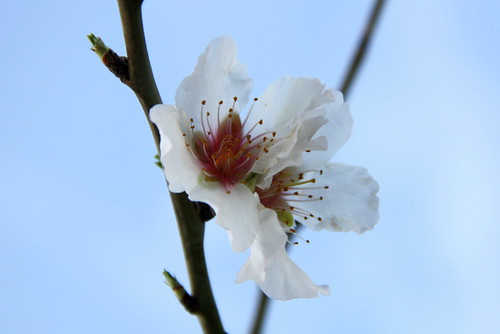
And it came to pass, that on the morrow Moses went into the tabernacle of witness; and, behold, the rod of Aaron for the house of Levi was budded, and brought forth buds, and bloomed blossoms, and yielded almonds. (KJV, Numbers 17:8)

Almond Flowers
Almond Flowers image courtesy of Flickr user Avital Pinnick via a CC license

Friday, September 24, 2010

Thursday Book Questions on a Friday, Pt. 2

As promised, I will continue to poke my head in here to answer Jenna St. Hilaire's Thursday Book Questions. I'll also use these lines in the header to offer a brief update on life as a librarian/theology grad student.

This week has been very busy--I taught three information literacy classes this week, one of which was for an English lit class, which was fun. They were doing secondary research on some aspect of a short story they read, so I showed them how to go about doing that.

On the theology front, I'm currently taking a class called The Early Church, in which we are reading primary texts from the first thousand years of the Church. This week, we're reading Athanasius's Against the Arians. In fact, I'm spending this Friday evening at the reference desk trying to get through as much of it as I can (it's a pretty long text).

And finally, I am preparing for a presentation I'll be giving next week at a librarians' conference in Savannah, GA, called the Georgia Conference on Information Literacy. It will be my first time to Georgia, so I am super excited about that. I'll be presenting with my research partna' Teresa Grettano, and our presentation is called:  "I Found it on Facebook": Social Media and the ACRL Information Literacy Standards. We'll be taking the information literacy standards for college-level students and showing how user behaviors on social media sites like Facebook actually lay the groundwork for information literacy skills. This thesis is a bit radical (ha), but something I am incredibly committed to. Teresa and I have been working on this research since last year, and will continue to do so for at least another year, maybe more. Next week will be my first conference presentation though, so I'm a little nervous, but mostly excited for the opportunity.

All of that being said... I love my job. :)

And now, on to the Thursday Book Questions. For last week's questions and answers, click here.


6. Do you have an e-reader?
No I do not. I am not opposed to owning one someday though. I am waiting for the gadgetry to evolve a bit more, so I can have more flexibility with what I use said gadget for, including reading e-books.

7. Do you prefer to read one book at a time, or several at once?
Prefer? I mean, in a perfect world I would read one book at a time... and that would be my only occupation every day. But being the busy-bee that I am, I almost have no choice but to read more than one book at a time, otherwise I would never get to all the titles I'd like.

8. Have your reading habits changed since starting a blog?
Ha, I don't blog often or regularly enough to have a valid answer to this question. Even if I did though, the answer would probably be "No," since I have always read as often as I can, given a very busy schedule. Blogging hasn't radically altered that situation much for me.

9. Least favorite book you read this year (so far?)
Hmmm... This is tough, partially because I can't remember everything I tackled in Spring. I was not a huge fan of the book Theology of Wonder, which I offered my impressions about in July. It was good, but not great--for me at least.

10. Favorite book you’ve read this year?
Definitely a difficult question considering, again, I can't remember all the books I read in Spring. I do know I read the Artemis Fowl books, which I absolutely adore. I think it was the story that surprised me most this year, in terms of just *how* much I wound up loving it. If you haven't read these books, and you're into YA stories of the fantastic type (but good ones), I highly recommend that you do.