Wednesday, March 7, 2012

"Welcome to Pinterest!": A Case Study

Yesterday afternoon, I decided to join Pinterest. Until this weekend, I did not have a need to add another social media website to the small but manageable set I currently belong to. Without a need to be met, there was no real reason for me to seek an invitation to join the hottest new social media startup of 2012, so I didn't, despite the fact that many of my friends both on and off social media sites are active users of Pinterest and absolutely love it.

But then I started working on our little Rosebud's registry (still a work in progress!) and all that changed.

It turns out that Babies-R-Us only has three "sort" options for displaying the items you've added to your registry: Product Category, Price: Low to High, and Price: High to Low. The latter two are intended for gift-givers, but the first option should be very useful for the parent creating the registry, to take stock of how many different items have been added to any one category. However, Babies-R-Us has a rather arbitrary way of deciding what products belong in which categories, with random categories that have no real meaning to the consumer, such as "Top Baby Registry Items." I think this category refers to popular items which are very often added to baby registries on the site, but it takes items that should be classified under, say, "Diapering" and moves them to this arbitrary category as a result of their popularity. This grouping is less than useful, and the confusion was beginning to drive me nuts, especially since the entire process of registering for our baby was overwhelming to begin with--but that's perhaps a blog post for another day. Confusion and frustration characterized much of my registry experience using the Babies-R-Us interface.

Enter Pinterest.

I realized what I needed was a place to sort through the visuals of each product I added, categorize them in ways that were meaningful to me, see where there was redundancy and also where there were gaps, and work from there. And the main reason Pinterest appealed to me for this functionality is the fact that each image you "pin" on a board on the site is linked back to its source page--meaning, I could organize the visual version of Rosebud's registry on Pinterest while still linking back to the products on the Babies-R-Us website, where my actual registry is housed. Without being a Pinterest user myself, though, this system/solution was only theoretical for me. I was unsure it would work this way in practice. But it was a strong enough reason to seek out an invitation to join the site, and so I did.

***

I've decided to keep a log of my impressions of Pinterest as I get the hang of using it. More specifically, I plan to describe what I do on the site, analyze why I do it, and articulate the significance of my actions and their causes. This will inevitably include a critical analysis of the site itself, identifying where the functionality succeeds and where it falls short, when considering my specific goals for using the site. This exercise is actually something my research partner, Teresa, and I have our students do in a course we co-designed last year called Rhetoric & Social Media. Our research (and the course) focuses largely on that other popular social media site, Facebook, however our deeper interest is not so much the site itself, but the thought processes of users as they encounter information on the site, and the effects of the site's functionality (much of which is shared across the social web) on how users relate to the information they encounter.

As I started messing around on Pinterest last night, I found myself reflecting analytically on how I was navigating the site to achieve my goals, and I realized it is providing me with the perfect case study to share here on my blog. I think keeping this log will be good practice for me, since we have our students do this work regularly, and having an opportunity to practice the skill of articulating description-analysis-significance for myself will improve how I teach it to my students.

A final question that you may be asking yourself is: what's the point? Why bother describing, analyzing and articulating the significance of my actions in relation to information? What is to be gained by developing and practicing this skill? (In other words, why have Teresa and I decided to focus the bulk of our research energies on this kind of work?)

The answer, in a word, is meta-literacy.

As for what that word means exactly, at least in my research with Teresa...I'm afraid this post is already too long, and I haven't even started sharing about my first impressions of Pinterest yet! I'm hoping its meaning will become clear over time, and since I believe it plays a role not only in my research but also in other parts of my life (for example, it's playing a role right now in my decision to post here on my blog about my Pinterest user experience), I can promise the concept will be fleshed out in future posts.

To start things out, I will say that the narrative I began this post with is what rhetoricians would refer to as my purpose (as well as my context) for choosing to join Pinterest, where my purpose and context are just two parts of what we'd call my rhetorical situation on the site. (Other parts include my attitude, background, audience, and more, all of which will also affect my actions on the site). A person's purpose in relation to participating on a website like Pinterest (or Facebook) can (and almost always does) change and evolve over time as a result of many factors. But at the outset, visually organizing our little Rosebud's registry was (and still is) my primary purpose for joining Pinterest, and helps define my rhetorical situation at the outset.

I'll stop here for tonight. In my next post in this series, I'll share the process of actually creating my Pinterest account--and yes, there were significant rhetorical decisions I had to make even at that early juncture!

Stay tuned.

(And if you managed to read this far, you've just received a fair taste of what my library-related research is like...can you blame me for loving my job?)

Inspiration board (for BYW)
Image courtesy of Flickr user Daily Suze courtesy of a CC license

Wednesday, February 29, 2012

Leap Day News

Today was an exciting day for me and my husband and our growing family. I'm in the 19th week of my pregnancy, and this morning we went in for our second trimester check-up and ultrasound. We are very happy to report that everything about our baby at this stage of development looks normal and healthy (yay!). Baby was kicking up a storm throughout the proceedings, though I can't feel all of Baby's kicks yet: I feel a flutter now and again (= so awesome), but it will likely be another week or two before Baby is big enough for me to feel movement all of the time. All of Baby's bones are present and accounted for: seeing this up on the ultrasound screen was so amazing. And, Baby's size and shape all indicate that the due dates we've been working with (July 23-25) are still spot on.

Waving 'Hello!' Look at that hand--so darned cute!

This is also the point in the pregnancy when it's possible to learn the sex of the baby, if the baby cooperates and the parents wish to know. Paul and I decided we wanted to know, providing of course Baby decided to reveal this information to us. We would be excited either way, but knowing would allow us to relate more fully to Baby while Baby is still in the womb--our job as parents began 19 weeks ago, after all.

Well, Baby was acting rather demure this morning when the cameras were rolling, sitting up with legs crossed versus head down with rump up; the latter position makes it much easier to get a view of the necessary anatomy. However, our ultrasound technician with almost 30 years experience managed to find an angle where she could say...with quite a fair amount of certainty (85% she said)...that our little one is...


Monday, February 27, 2012

Facebook and the Blossoming Rod of Aaron: A Researcher's Tale

I am currently pursuing a graduate degree in Theology at a Catholic institution (the same one I work at as a librarian), and find myself in a required course called Old Testament (OT) Exegesis. Now, being an Orthodox Christian, I'll be honest and say that my only real exposure to the OT has been liturgical, and even then my liturgical exposure has been limited mostly to Holy Week (i.e., the week before Pascha/Easter). The main exception to this limited exposure is the Psalms--we hear and pray through the Psalms at almost every service throughout the year. Perhaps there are other exceptions as well that I haven't caught.

[To the Orthodox liturgical folk who may be reading: Did I miss any other instances of the OT in our weekly liturgical cycle?]

All of this being said, I went into this OT Exegesis course not knowing all that much about the OT, except the very basic structure, some of the more popular stories, and the simple fact that we in the Church read and understand the OT first and foremost through Christ, continuing the tradition passed down from the Early Church. On a basic level, I am excited to be in the course because it is giving me a lot of knowledge about the OT Scriptures themselves, which is never a bad thing. We're reading a lot of Jewish commentaries, which is really neat and fascinating as the books of the OT are shared by our two faiths.

For our term paper there is a very narrow focus within which we can choose our topic of choice. The narrow focus is: the OT book of Numbers, Chapters 11-36. We're to write an exegetical paper on our passage of choice from this book. ... For me, this was like someone saying: "Pick your favorite Baroque piece of music. Ready, set, go!" (I am not an expert nor even an amateur at recognizing Baroque music.) Needless to say, choosing a passage was going to wind up being more arbitrary than I'm used to when it comes to choosing a research topic, but such was the nature of the thing--if grad school is anything, it's humbling!--so away I went.

My husband suggested helpfully that the first place I look be the Ancient Christian Commentaries volume on Numbers to see what the Church Fathers had to say (in digest-format at least) about the various passages in that book. After a cursory skim of the various headings, I landed on an image I recognized from the hymnography in church: the blossoming rod of Aaron (Numbers 17:1-11). Based on the volume I was reading it was clear the Church Fathers had enough to say on this passage, and it struck a deep enough chord in me from having encountered it liturgically, that I decided it would be my passage of choice for the paper. But even though I knew I had encountered the image before, for the life of me I couldn't remember what it meant.

And this is where things start to get interesting: I decided to take the question to Facebook. Among my numerous Facebook Friends are many fellow Orthodox Christians, with a noteworthy number of Orthodox priests among them. I figured, if anyone out there could remind me what the image usually means when it comes up in our hymnography, someone in my Facebook network could.

I posted the question as a Status Update: "To my scholarly Orthodox friends, quick question: What are some of the interpretations of the rod of Aaron in our tradition? I know I've heard it come up time and time again in hymnography (particularly the blossoming of the rod of Aaron, which is what I'm especially interested in), but I'm drawing a blank as to precisely the ways in which it's used as a symbol/type. Thanks in advance!"

[It's worth noting that I landed on the idea to pursue the blossoming rod of Aaron while at work, and my husband was otherwise occupied at work himself, so he was not on hand to ask. He would have known the answer to my question, having been raised in the Church and being a seminary graduate who often serves in the altar. But my research impulse was too strong to wait until I got home, so I took it to Facebook.]

Lo and behold, within a few hours I had a total of three different Facebook Friends leave useful responses: a priest, a deacon, and a reader in the Church. I learned and/or was reminded that the blossoming rod of Aaron is tied symbolically to: Mary the Virgin Mother of God (she bore Christ without seed just as the rod blossomed miraculously without seed), the grace-filled priesthood (the blossoming of Aaron's rod over the others indicated his election to the priesthood through grace), and the cross of Christ (which bore Christ in the same way the rod bore blossoms). These images rang true to my understanding, and I felt even better about my choice of passage than I had before, all thanks to my resourceful Facebook Friends.

But I still had the difficulty of eventually tracking down scholarly sources about this particular passage, to be used in the paper itself. The line between primary and secondary sources in theological studies (particularly in interpretation of Scripture) is very...fuzzy. In general, you'd assume primary sources are better, right? Normally you'd be correct, but that assumes the researcher has developed the toolbox, skills and mindset required to rightly understand those primary sources. Usually this is where secondary sources come in...but what if your secondary source of choice is a Church Father writing over a thousand years ago? Doesn't this in turn become a primary source in its own right? (Answer: It does.) You can see how it can get complex, with the layers of meaning and interpretation involved in this kind of work.

So, what to do? For me, once again the answer was to be found on Facebook, only this time I would direct my question to a narrower community of Orthodox scholars who study this stuff on a regular basis, versus the wider group of the Orthodox faithful I directed the first query to (and intentionally so, as the first piece of information that mattered to me was the understanding of the image in the context of liturgy and worship--this is always where my theological investigations begin and end).

The community in question is a closed Group on Facebook containing Orthodox scholars. The group is made up of: working or independent scholars who study Orthodox theological topics for their research, graduate students in Theology with a focus on Orthodox/Eastern Christian studies, or faculty in other research areas who happen to be Orthodox. I am a member of the group by virtue of the second and third categories. The existence of this Facebook Group is an exciting endeavor in the land of Orthodox-scholars-who-Facebook, and I am honored to be included in it. (The group currently has 183 members.)

So, I posed my research question to this group, knowing I was now addressing my colleagues, fellow scholars and in most cases those with far more expertise than I in this area. I won't copy my posed question here, as it was quite long, but in sum I asked for suggestions of works and scholars who interpret the OT, the book of Numbers, and this passage in particular through an Orthodox scholarly lens.

The result? A comment thread 28 comments long containing loads of recommended resources, as well as the names of several Orthodox scholars whose focus is OT interpretation and who have written on the topic. And being a librarian, I found myself, over the course of an afternoon/evening at the Reference Desk, tracking down each recommended resource in "real time" as the comments came in. It was a very fruitful evening at the desk, to say the least!

Now of course I haven't had a chance to consult the resources in detail yet, and many are not yet in my possession but have been ordered/requested and are on their way to me. The term paper isn't due until the end of the semester, so I have some time. And I have a lot more to learn from my professor about his expectations for us with the paper. But at least I know I have a reliable body of work to delve into when it comes time to dig in and exegete, interpret and understand this OT passage containing the blossoming rod of Aaron.

Not bad for Facebook, if you ask me.

***

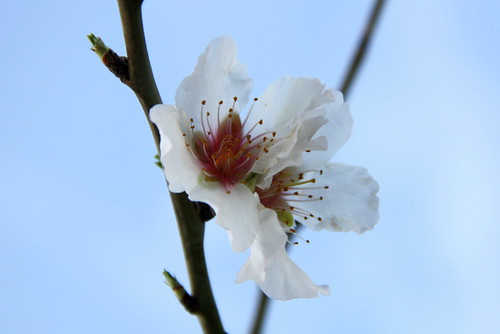
And it came to pass, that on the morrow Moses went into the tabernacle of witness; and, behold, the rod of Aaron for the house of Levi was budded, and brought forth buds, and bloomed blossoms, and yielded almonds. (KJV, Numbers 17:8)

Almond Flowers
Almond Flowers image courtesy of Flickr user Avital Pinnick via a CC license

Tuesday, February 21, 2012

A Different Kind of Family

On the evening of November 22, 2010, I wrote an introductory email to a gentleman I had never met before. A mutual friend had told me about this gentleman, and suggested we might have enough in common to merit an introduction. Upon learning the gentleman was a professor of religion and actively involved in his church, I agreed with our mutual friend: "Yes," I thought, "this gentleman and I, both of whom work in academia and share the same faith, do in fact have a lot in common." I wrote the email.

For the sake of orientation, it's worth noting that three days later, I published my last substantial post before taking a hiatus from blogging that lasted a year and three months, the reason for which should soon be apparent.

The gentleman replied to my email the following day. A lively and engaging correspondence unfolded between us, and several weeks later we decided it would be worthwhile to meet. On a Friday in mid-December, he drove the two hours that separated us to come and meet me.

What the next year had in store for us, I could not have guessed. The gentleman became my fiance that following spring on April 25. He then became my husband on October 23, 2011. We are now expecting our first baby this upcoming July--which, I might add, is why I call myself a mother in my About Me description in the right-hand sidebar.

There are so many aspects of my story of meeting and marrying Paul (my gentleman) that I could choose to focus on in this post. Instead, I want to share about my transition from being a single independent woman in the library profession, to being a happily married mother-to-be in the same library profession. The "rightness" of this transition has everything to do with the woman my husband encountered as the year turned from 2010 to 2011, a woman very different from the one she had been a few short years previous...

***

On New Years Day 2011, just a few weeks after we had met for the first time, Paul and I shared a meal at a lovely little restaurant and talked about our personal hopes, dreams and plans. I explained to him that there were three relationships in my past that I would call "serious" to a greater or lesser degree, that during each I thought the relationship would lead to marriage, and that in each case God had a different plan and the relationship ended. Simultaneous with these relationships, I earned my Masters degree in Library Science, moved to a new state, and began work as a professional librarian in a university library. I confessed to Paul that before I got my degree, the strongest calling I felt was to marriage and motherhood; my library degree and any subsequent work was something I would do to "bide my time" until that "greater" calling was fulfilled, at which point I would happily walk away from my work in order to devote my full attention to my husband and children. It's worth noting, of course, the (now humorous) folly of my younger self in counting on the fulfillment of a calling that was completely out of my control, that being marriage and family life, as my record in that life category up until then did not bode well for me (to put it mildly!).

However, as I told Paul in that lovely little restaurant, during the intervening years a second, equally strong calling emerged, particularly once I started working professionally: the more I worked as a librarian, the more I realized that if I was indeed called to marriage and motherhood, they would likely co-exist alongside (and interwoven with) an active professional life as a librarian. My work had grown from something with which to "bide my time," into something I was meant to be doing for its own sake, as a means to share knowledge and serve others. After many years of struggling with images of family that never quite seemed to "fit" when I tried them on--images containing the stay-at-home mom I never had (and in retrospect would never trade for the hard-working, mother of self-sacrifice I did have)--after trying to insert myself into an image of family that never quite felt like home, the fittingness of my work had finally revealed a picture of what family could look like with not one but two working parents, at least one of whom found her occupation in (crazy, challenging, rewarding) academia. And this latter picture was finally one that felt right, and was likely to be the one I was called to, if I was called to any at all.

Paul listened to these things I told him about me, about the woman I had become versus the woman I used to think I was. He understood me, respected me, and supported me (and hey, he grew to love me too--not a bad deal if you ask me). And in the end (well, eight months later), he embraced them for his own when, in the midst of planning our wedding for later that year, he willingly chose to relocate so that I could continue to work in my current job--a job I absolutely love, but which I do ten times better now that I get to do it with him by my side.

***

Northeastern Pennsylvania (where we live) is home to many colleges and universities, not to mention a seminary or two, such that Paul has also been able to find work in his area of expertise. In this we are very blessed. It also means we are both academics--a comfortable (if sometimes nutty) marital fit for us both. And with the addition of our little one this upcoming summer, that different kind of family, the image of which finally felt "right" when I described it to Paul in that lovely little restaurant on the first day of 2011, is about to become a reality.

Photo by Ksenia of Eighth Day Photography
(our amazing wedding photographer)

Thursday, February 16, 2012

Return

How does one begin chronicling again, after so long away?

It's a question I don't have a ready answer to, but perhaps I will by the time I finish writing this.

***

So, I'm back, with firm plans to post as consistently as a very busy work and family life allow. I've been contemplating this return for quite a while, and the reason it's been tricky is because of the amount that has happened since my last substantial post from a year and almost three months ago. Furthermore, I knew I wanted to expand my scope and reader-ly audience to include other librarians doing similar daily work to mine, which meant conceiving of the blog in a new way. However, I was also determined not to leave behind certain things about my writing style from Librarian in the Kliros including the sharing of personal stories in order to better perceive cosmos in the chaos we so often find ourselves in.

And so, the result is an attempt to defy all the well-established rules of "what makes a successful blog," that is, the general encouragement to choose to focus either on personal matters (family, faith, etc.) or professional ones. I'm determined to focus on both. *shrug* It's my blog.

The more I reflected on this, the more I realized it is precisely because I make my library work personal that I feel I do a decent job at it, which in and of itself is worth blogging about. And I have so much to share about my work life, and so much to share about my home life, that I think I'm ready to dive back into regular blogging again, about both. But this is going to be both a professional space as well as a personal one. I'm considering utilizing labels to distinguish what topics posts are primarily about (I am a librarian, after all), but we'll see what shape that takes moving forward. For now though, some necessary housekeeping, mostly for the sake of my past subscribers (all 10 or so of you *waves*):
  • I imported most of my posts from Librarian in the Kliros (new nickname: LitK) to this new blog. I have added the label "Librarian in the Kliros" to these in addition to the labels they had before, which may or may not stick around depending on what categories develop over time. 
  • LitK will continue to exist in retirement, mostly because I didn't update my imported posts in the places where I link back to older posts of mine. For the time being, those links will take you to LitK posts, though someday I may do the maintenance required to update those links on my imported posts here.
  • If you subscribed to LitK, I'd be ever so grateful if you'd update your subscription to this new blog instead. It's my new home in the blogging world, and I'd love to remain in touch with all of you. 
I'm going to reign this post in for now, even though there are so many questions I'm leaving unanswered for many of you. I suspect a few may notice my "About Me" section in the sidebar and be thinking, "Wife? Mother? She never mentioned those things in her LitK posts! What on earth?" Another question all of my potential readers but one (Hi, Teresa!) probably have is, "What's the story behind the new blog name?" I look forward to addressing these questions and more in upcoming posts. But for now, if I don't get this "I'm back" post done and published I'll never get to tell those stories.

***

And so, it looks like I now have my answer to the question I posed at the beginning. I guess that wasn't as hard as I thought it would be. It feels good to be back.